This was originally a thread on Bluesky, but I soon realised it would work better as a topic here.
Something interesting just happened that brings some questions… I already knew that Standard Reader respects Bluesky’s blocks, and I’ve just seen it happening, not allowing me to open an article from a person that I just found out is blocking me (I looked it up to confirm, and It’s from a moderation list they are subscribed to on Bluesky, I don’t really mind but it’s not the point).
How did I even discover the article? From a Semble notification, somebody connected that article with one I have saved. The article in question is on pckt and I opened it just fine there, then I did what I usually do to manage my reading backlog for standard.site native documents: open on Standard Reader to save for later. That’s how I realized the author had blocked me.
Now that brings a question about blocking people while blogging, or curating your audience/readers/feed. Should standard.site blogs and apps respect blocks from different lexicons? Should they build another layer of personal moderation for each app, or for the whole standard? Or not at all?
I’m not saying I disagree with Standard Reader decision to respect Bluesky’s blocks, I actually think it makes some sense. I don’t want to see articles and publications from people I’ve blocked showing up while browsing through Standard Reader. But I also understand that people might have different opinions and decisions, so it should be discussed. Hoping to hear the opinions from Leaflet, Offprint, Mochott devs and users too (both people writing and people reading).
Edit: to be extra clear, I’m talking about individual and personal curation/moderation acts, not collective or broad moderation. Like blocking or hiding an author you dislike, blocking a rude reader from leaving comments and interacting with you and your publications, blocking or hiding publications you don’t want to see in your feed or reader.
5 Likes
A good question, and even better that we don’t need to all agree on the answer. Different interfaces/apps can make different choices here.
Personally, I wouldn’t want my interface to prevent me from reading a blog because the author blocked me via a Bluesky list. If I was blocked by a lot of people on Bluesky, I could see that being a significant factor in which interface I decide to use.
(That said, I would appreciate a warning/banner that says “{user} has you blocked via {list}. Would you like to continue?”)
3 Likes
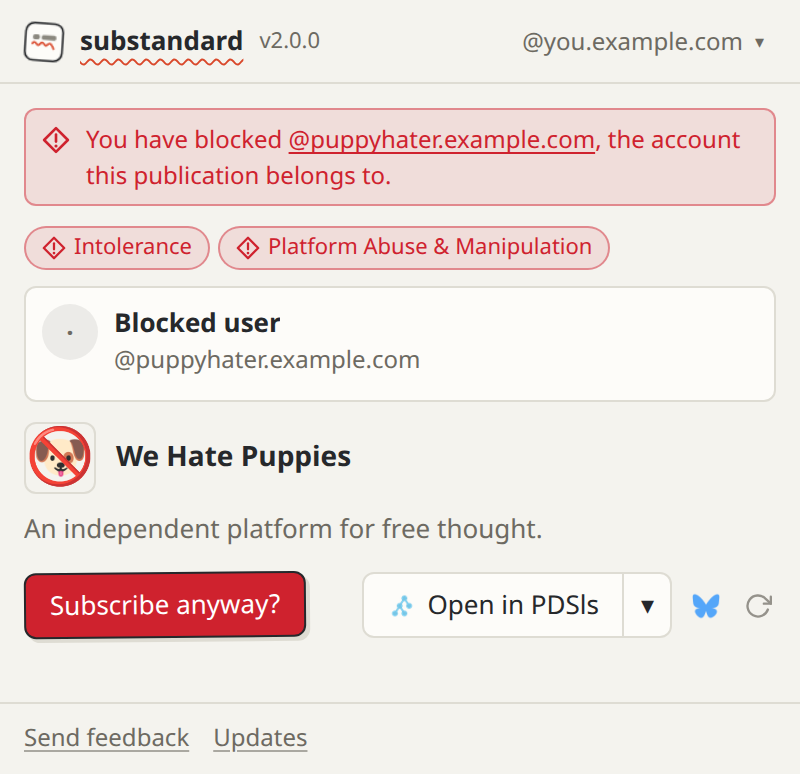
I did it like this for the Substandard browser extension:
My rationale is that if you’re using Substandard, you’re already on their webpage and indeed maybe on the article page. The important thing is to show you which user it is, and that you already have them blocked.
I think this scenario is a bit different for tools like Standard Reader, that might try to surface that user’s content to you if they didn’t respect blocks. More socially enabled tools like that should probably implement their own mute/block features, but a Bluesky block should be treated as an important hint or input.
2 Likes
Just an anecdote that might prove useful: I don’t have the original post, since I didn’t save it, but I once saw someone say something along the lines of:
Mutual followers on Tangled, mutual blocks on Blacksky, as it should be.
Goes to show that blocking or following, which you might think both might be something you’d want to share cross-app at times, can also be taken very differently in different apps.
3 Likes
I’m even an example of that. I have some people blocked on Bluesky that I follow on Tangled. I’m interested in what they are developing but not in what they are posting in the microblog at all. Not always can the block be reused across different apps, but I also agree with @permadeath.com that it could be a useful indication to surface, so people can make their own decision. Hence why I even thought about having a block just for the standard.site lexicon or for individual apps (Leaflet, pckt, Offprint, Mochott…)
2 Likes
It seems like it’s quite similar to the shared / different profile question between apps.
I think the ideal UX is probably going to be something like allowing you to import your profile, blocks, follows, etc. from other apps if desired, but defaulting to assuming that you might want it different.
Just to make it more complicated, I would probably be fine with people I block reading my leaflet, but not commenting on it. Same for something like tangled. Yes, check out my project, fork it if you want, but maybe I don’t want your PRs?
3 Likes