Hello @lemmaeof.gay! Exciting stuff. A few questions:
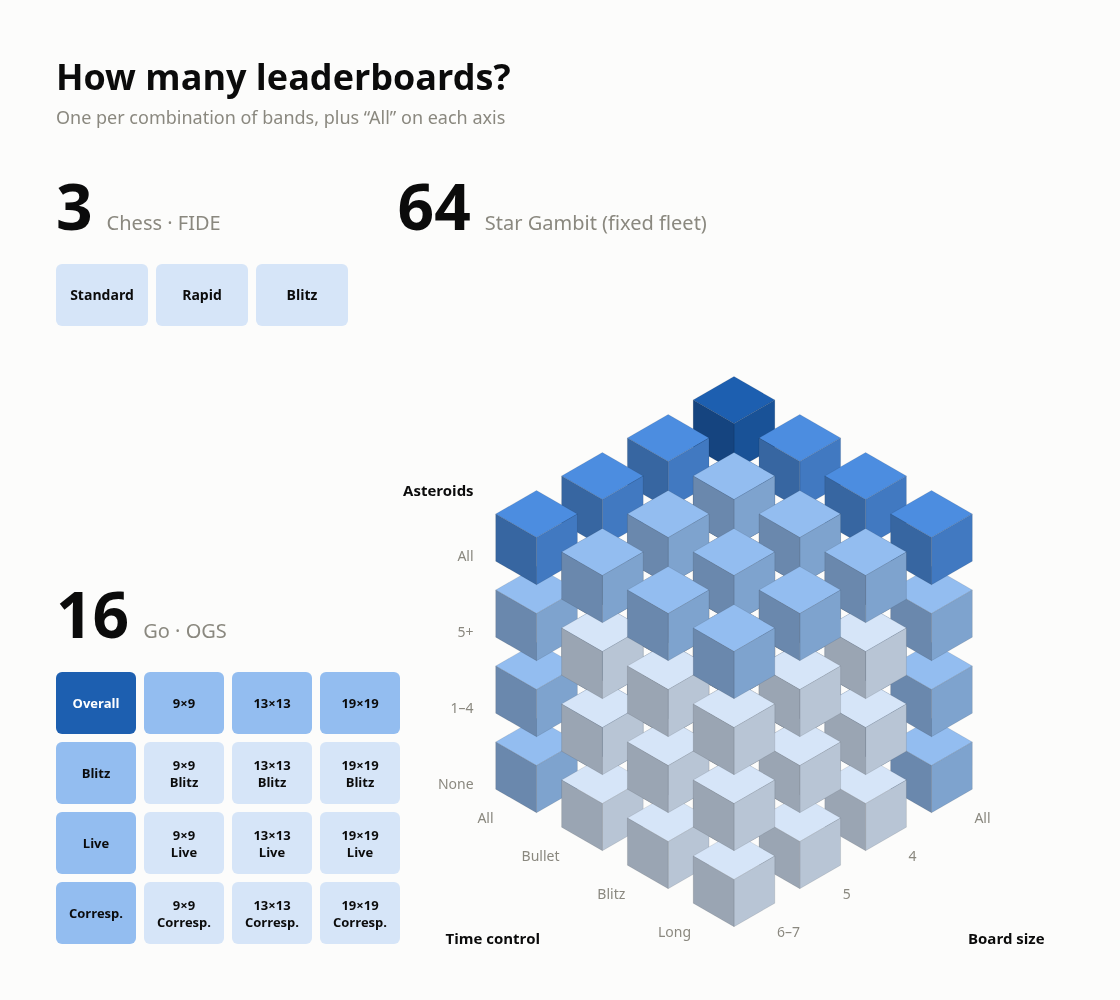
First, have you written at all about Tsunagite? I’m nearly ready to open-source a system I call PolyLeader, and I’d love to compare notes. It’s about computing many leaderboard across the same game database (think how the Online Go Server computes 16 leaderboards and each game counts for 4, except replace 16 and 4 with N and M).
Second, rating algorithms. Defining one fully in a record such that a system could handle new algorithms is a cool idea, but I’m not sure I understand the need.
Consider
My plan is to have write the game records to the authoritative service’s repo, while allowing players to optionally keep a copy in their repo. Then, the service computes a number of leaderboards (currently all glicko-2), then writes the resulting outputs to the protocol (including historical ratings, so the entire rating history can be constructed). Perhaps a competing service makes a different judgement call about a disqualification, resulting in different ratings that they can publish themselves. While I was already planning to include a note about how the calculations were done in the proposed rating.scale lexicon, help me understand what I stand to gain by implementing Glicko-2 in CEL and publishing that instead.
While I agree that benefit is big for trust, FIDE had it decades before atproto was imagined simply by using Elo, publicly defined in a paper. A more formal way to define the algorithm could make it a little easier for people to verify things, but does that difference actually matter?